

Find the compass of customer value
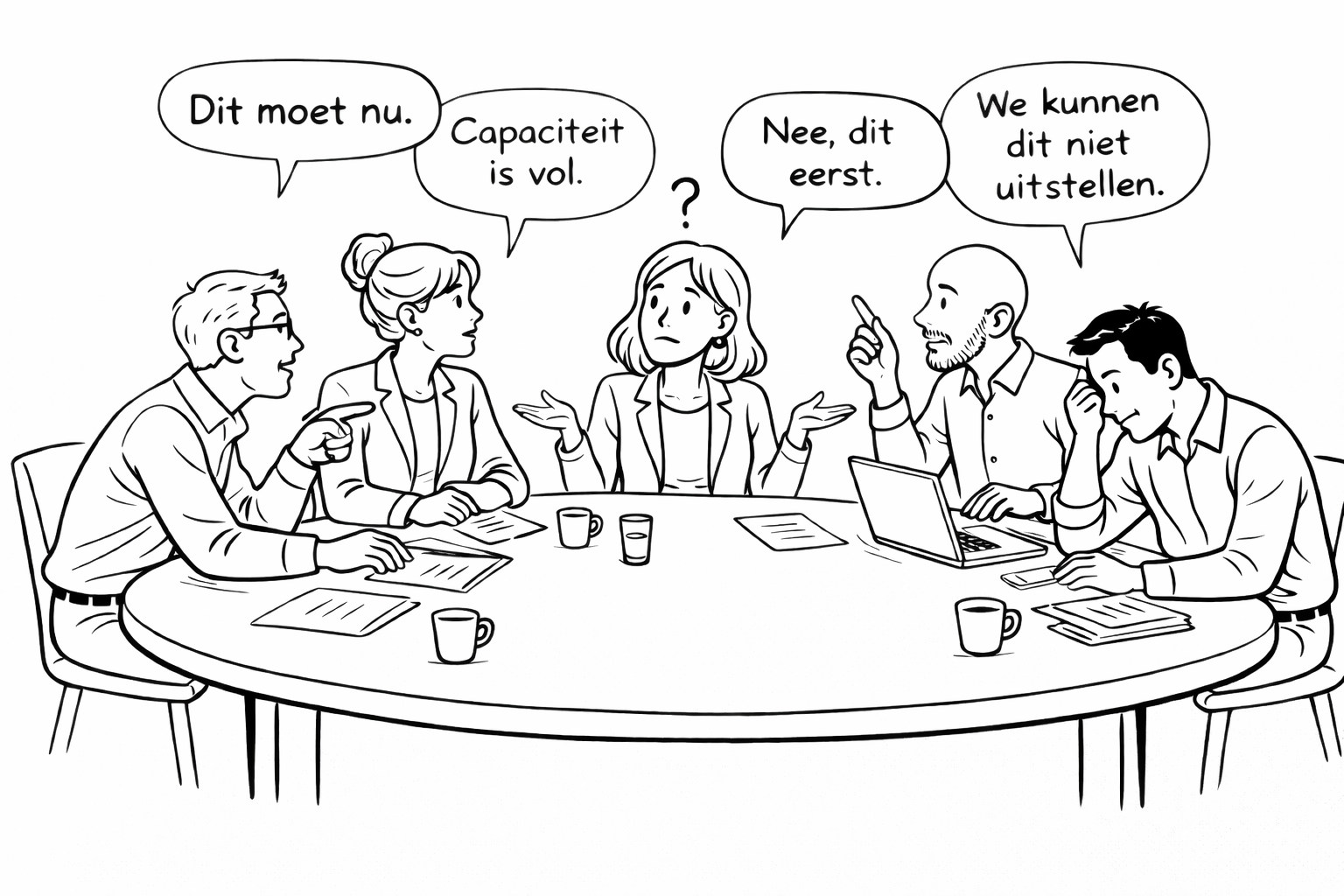
Internal discussions are increasing. Not because people don’t want to work together, but because everyone has a good story to tell based on their own responsibilities. One theme seems urgent, another strategically important. The arguments are strong in terms of content, yet the MT cannot reach a conclusion. What is striking is that the discussion rarely explicitly concerns customer value. It is about capacity, planning, risk, progress, reputation, and deadlines. But the question of what value we deliver to which customer and what we lose most if we wait remains unanswered. And that is precisely where the confusion begins.
1. Without insight into customer value, the loudest voice prevails
Many organizations say that the customer is central. In daily practice, however, internal metrics prevail: occupancy, progress per portfolio, budgets, feasibility. That is understandable; those signals are visible and influenceable. But this focus has consequences.
Research among hundreds of organizations shows that strategic clarity explains a substantial part of the performance difference between high- and low-performing companies. When priorities are not explicitly linked to customer value, departments automatically optimize their own turf. Everyone acts rationally, but from a different perspective.
One team focuses on implementation certainty, another on revenue opportunities, and yet another on feature adoption or efficiency. There is something to be said for each argument. However, these optimizations tend to work against each other rather than helping the organization as a whole. In research, this is referred to as a “misalignment tax,” which consists of wasted resources, delayed decision-making, and lower responsiveness to the market.
As long as it is not clear which customer need is leading, there will be no shared priority. Without a shared view of what is most important right now, the discussion will continue to grow.
Marianne
2. Priorities per domain hinder the whole
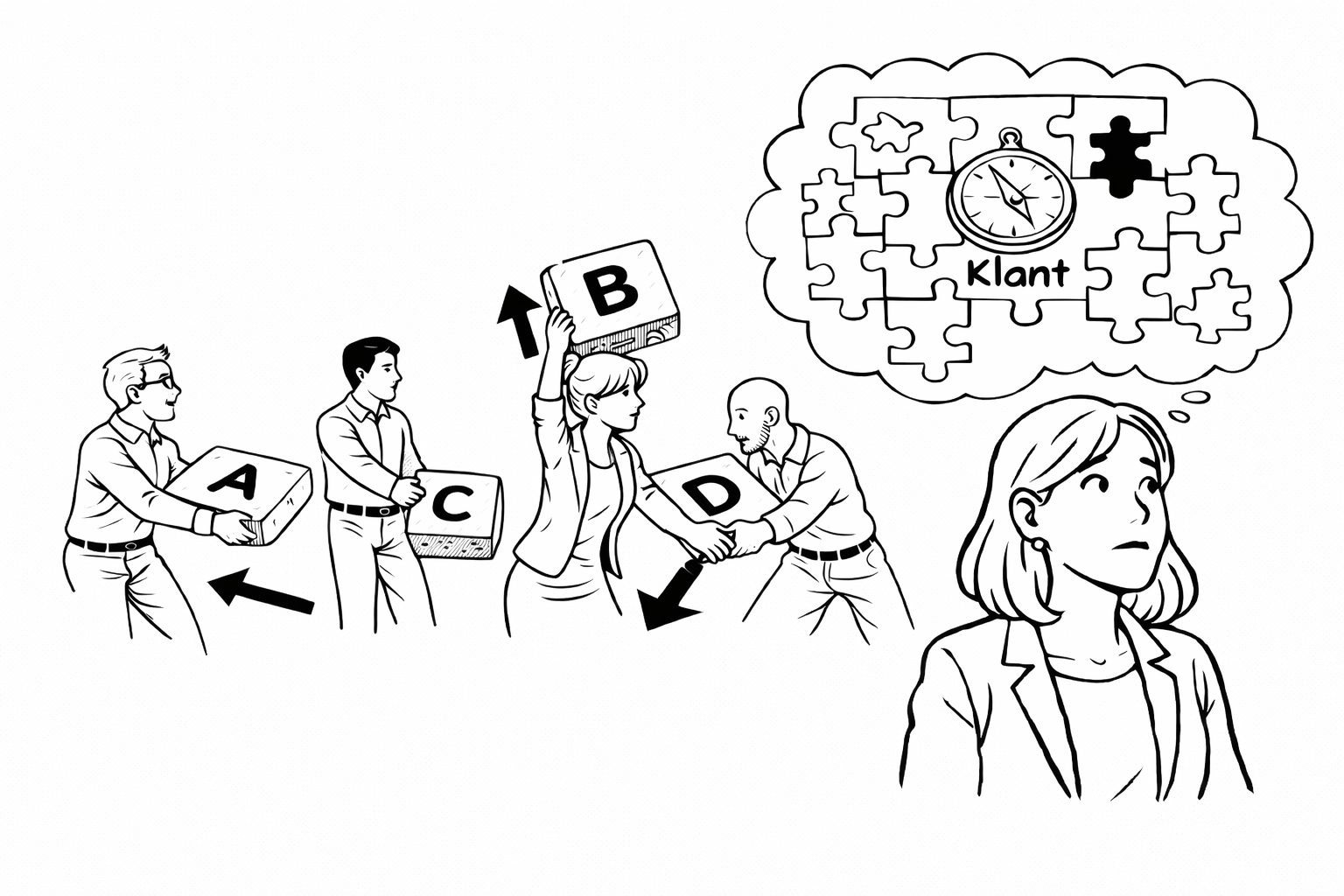
In many organizations, responsibilities are clearly divided. Each theme and program has an owner. This provides clarity, but also creates barriers. Capacity is monitored within those barriers. Initiatives are launched as soon as there is room for them, even when something with a higher customer value is waiting elsewhere.
This creates a structural paradox. In one part of the organization, people are working hard on things that are “simply planned,” while elsewhere, something time-critical remains undone. Research shows that employees spend a significant portion of their time on work that does not directly contribute to strategic goals. This is not a lack of commitment, but a consequence of how the system is set up.
In knowledge and IT environments where workloads are invisibly waiting on hard drives or in the cloud, this effect is even stronger. Donald Reinertsen (the inventor of WSJF prioritization in SAFe) shows that the differences in Cost of Delay between tasks in these environments can be enormous. With some initiatives, we lose tons of money every day when they are postponed, while others can wait without any significant impact. If these differences are not made explicit, we treat these initiatives as if they are equal and everything seems equally important.
The result is predictable: long queues, increasing workloads, and delayed delivery of real value. We start a lot, but finish little.
3. Without clear prioritization, loudmouths win
As soon as prioritization is not done collectively, the nature of the conversation at the MT table changes subtly. It becomes a sum of the most loudly substantiated interests. In this process, economic considerations lose out to the loudmouths.
This is not a lack of team spirit. It is a structural consequence of implicit criteria. Research into decision-making in management teams shows that when shared assessment criteria are lacking, discussions take longer and decisions are more often reopened. Moreover, many managers are unable to pinpoint their organization’s top priorities. This creates what is sometimes called “alignment theater”: it appears that there is agreement, but underlying differences remain.
The impact is measurable
The relationship between alignment and performance is not a soft factor. Organizations with a clear link between strategy and prioritization demonstrably grow faster and achieve higher profitability than organizations where that clarity is lacking. Decision-making speed and employee engagement also appear to be directly related to the extent to which priorities are explicit and shared. For a management team, this is not an abstract issue. It directly affects value creation, lead time, and ultimately results.
What can you do differently tomorrow as an MT?
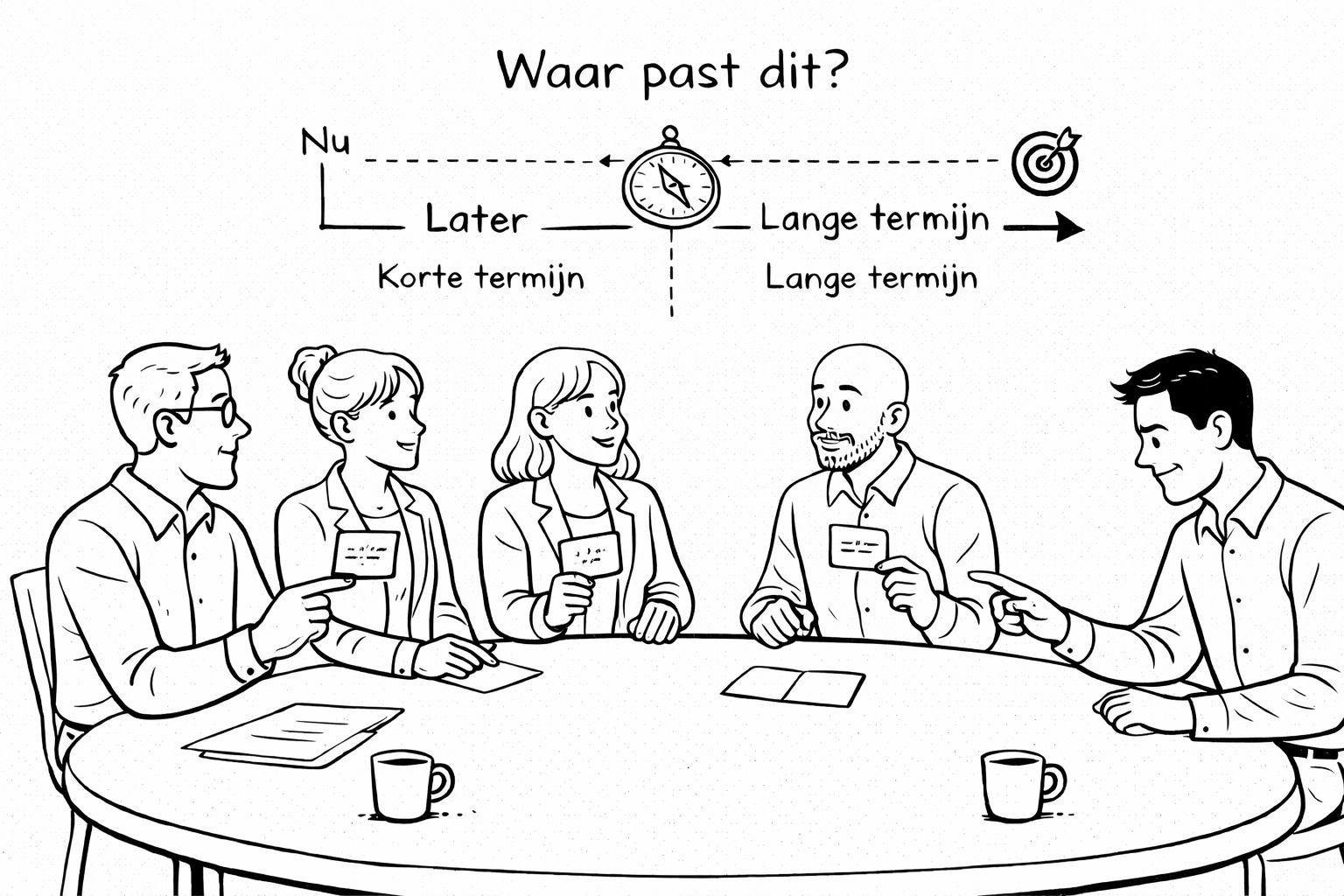
The first step is simple but powerful: make customer value explicit in every priority discussion. Consistently ask the question: which customer loses concrete value if we postpone this, and how much? By making urgency and impact visible, the conversation shifts from “Whose is this?” to “What does this deliver for which customer?”
The second step is to prioritize together. Bring all current initiatives together in a single overview and enforce an explicit order. Methods such as Weighted Shortest Job First (WSJF) prioritization help to make differences in customer value and urgency visible. By then weighing this Cost of Delay against the effort involved, insight into the importance for the organization is gained. The goal is not to make the perfect calculation, but to jointly investigate why, from an economic point of view, this is currently the most important thing for the organization as a whole.
https://youtu.be/du2WV1IbULU?si=ByWfDI-3BIr60cK4
Simply making that order explicit breaks through many recurring discussions.
At the same time, it is too simplistic to lump all work together. Capacity for continuity and innovation, in both the short and long term, each require their own space. Clear frameworks at MT level about how much capacity you spend on what help with this. In a subsequent contribution, we will explore how such guardrails help to create focus without disrupting the running organization.
To conclude
When internal discussions increase, the reflex is often to invest in better collaboration. Training courses, offsites, new consultation structures. Perhaps that is not necessary, because the cause is not behavior, but the lack of a shared value compass.
Delivering value requires more than just hard work. It requires explicit choices about what matters most to the customer. Only when those choices are made jointly and transparently can priorities be settled and space created to truly finish what has been started.
The link with our previous blog
In a previous blog, we showed why maximum occupancy slows organizations down. When everyone is busy, everyone waits for each other, and the urge to respond quickly feels chaotic. We then looked at decision-making: how the same voices unintentionally determine the direction and why better choices arise when different perspectives are truly influential.
But even with more space and better conversations, one question remains decisive: what do we choose together? Because as long as it is not explicit what value we want to deliver to which customer, everything remains urgent and no clear order emerges. This blog therefore takes the next step: how do you, as an MT, make value leading in your priorities?
.
A technique you could try with your team
Collaboratively build a shared understanding of the way we plan to achieve a goal and our assumptions that guide that plan. This creates a shared basis for testing our assumptions and prioritizing our activities.
For just about any goal you want to achieve in an organization, people have to change their behavior. You can set up a nice organizational structure, offer tools and facilities, but if people continue to do what they did, nothing structurally changes and you will not achieve your goal. With Impact Mapping, you collaboratively visualize who can help you achieve your goal, which behavioral changes (impact) are needed in the organization to achieve your goal and how you can support that behavior change.

 English
  Nederlands
  Deutsch
  Français de Belgique