

The market demands a faster response to change – which feels increasingly chaotic
Many organizations recognize the same tension. Customers expect faster adaptation, the market is more volatile, and competition leaves little time to wait and see. The reflex is logical: work harder, plan more tightly, coordinate more. Do everything to pick up the pace. But what happens internally rarely feels like acceleration. Meetings increase, accountability piles up, and teams experience mainly unrest. Firefighting becomes the daily routine. Improvement is postponed to later, because there is no time for it now. This feeling is not due to a lack of commitment or professionalism. It is a systemic effect. And one factor plays a greater role in this than is often recognized: capacity utilization.
Why capacity utilization makes the difference between agility and chaos
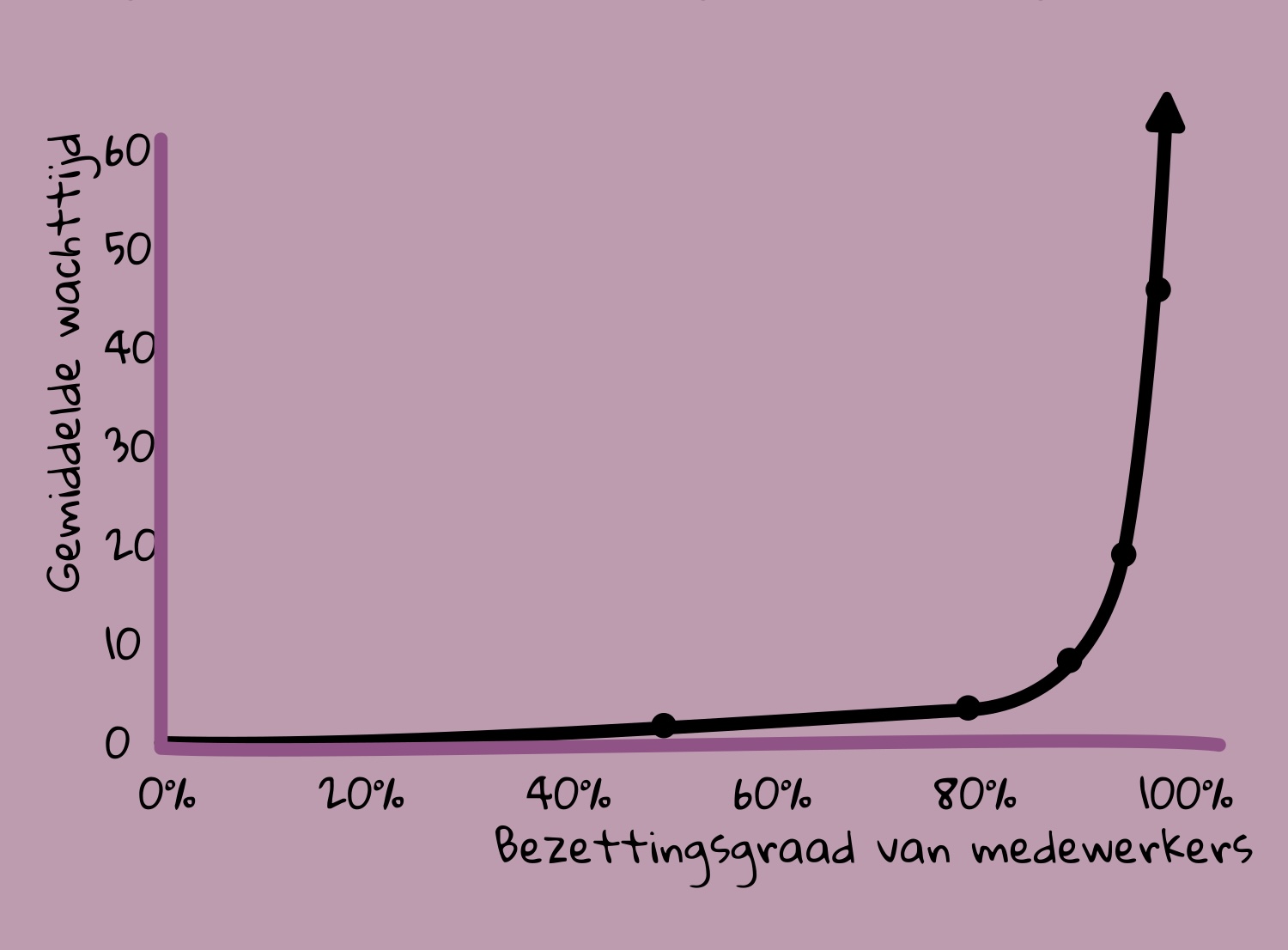
Research in queueing theory, operations management, and Lean has shown the same pattern for decades. Systems that are structurally overloaded lose their ability to cope with variation. This applies to factories and hospitals, but just as much to management teams, teams, and knowledge work. As long as the utilization rate is moderate, a system can absorb fluctuations. Small disruptions remain small. There is room to respond, recover, and learn. But as the utilization rate increases, that picture changes rapidly. The effect is not linear. That is what makes it so treacherous.
When meetings lose their purpose
This exponential effect has been mathematically proven and is repeatedly visible in practice. A small increase in demand when occupancy rates are high does not lead to a small delay, but to a chain reaction of postponements, extra coordination, and recovery work. In organizations, this is reflected in full schedules with no room for maneuver, decisions that remain pending because everything is a priority, increased consultation to distribute the pressure, and improvement initiatives that are postponed “until things calm down.”
The paradox: pressure feels like speed, but makes learning impossible
When the pressure increases, it feels logical to schedule people and teams more tightly. It gives a feeling of control. Everyone is busy, everything is running smoothly. But it is precisely this maximum utilization that makes the system vulnerable. Every new change has to be squeezed in somewhere. Every customer request competes with existing work. Improvement feels like something extra. Not because improvement is unimportant, but because there is no time or attention left to do it properly. This touches directly on the essence of continuous improvement. Continuous improvement is not about changing faster, but about continuously learning from what happens at work. And learning requires something that is the first thing to disappear under pressure: attention.

Continuous improvement requires rhythm, not speed
At its core, continuous improvement is surprisingly simple. It is about:
- paying attention to what keeps coming back
- consciously making time for it
- and doing so at a steady pace
Not as a separate action, but as part of the work. That rhythm is not universal. It matches the cadence of the team or the MT. A team that works together daily learns differently than an MT that meets monthly. The frequency and duration follow the work, not the other way around. That is precisely why continuous improvement does not work when everything is fully planned. Without space, learning disappears from view. Evaluations are skipped, reflection is postponed, and improvement becomes something for “later.” Later that rarely comes.
Transparency helps, but only if learning follows
In the previous blog, we considered the importance of clarity and visibility. Less consultation occurs when goals are clear and information is made visible. That transparency is important, but not sufficient.
Making things visible without time to learn mainly leads to more signals. Continuous improvement only begins when there is also room to investigate those signals together. Not everything at once, but one pattern, one recurring topic that deserves attention.
Transparency helps to see where learning is needed. Rhythm and time ensure that it actually happens.
Responding more quickly to change starts with slowing down at the right moment
The uncomfortable insight is this: if you want to respond more quickly to change, you have to dare to slow down somewhere. Not everywhere. Not always. But precisely where the work repeats itself and calls for improvement. This is not a loss of momentum, but an investment in agility. Maximum occupancy feels efficient, but takes away the space to learn. Continuous improvement requires attention, an appropriate rhythm and the time to improve one thing at a time. Organizations that dare to do this are not slower, but better able to move with what the market and customers demand.
Structural improvement a practical tool
Structural improvement of the team’s way of working by regularly taking time to inspect and adapt and leveraging the wisdom of the entire team to more effectively deliver value to the customer.
Regularly take time to inspect and adapt your way of working. This ensures that you improve as a team. By doing this in a varied way, you stay sharp in creating more and more value for your customer.
- More proactivity in removing impediments
- Smoother collaboration
- Increase in job satisfaction
- Greater focus on developing craftsmanship

 English
  Nederlands
  Deutsch
  Français de Belgique