

Why do we keep running into the same problems?
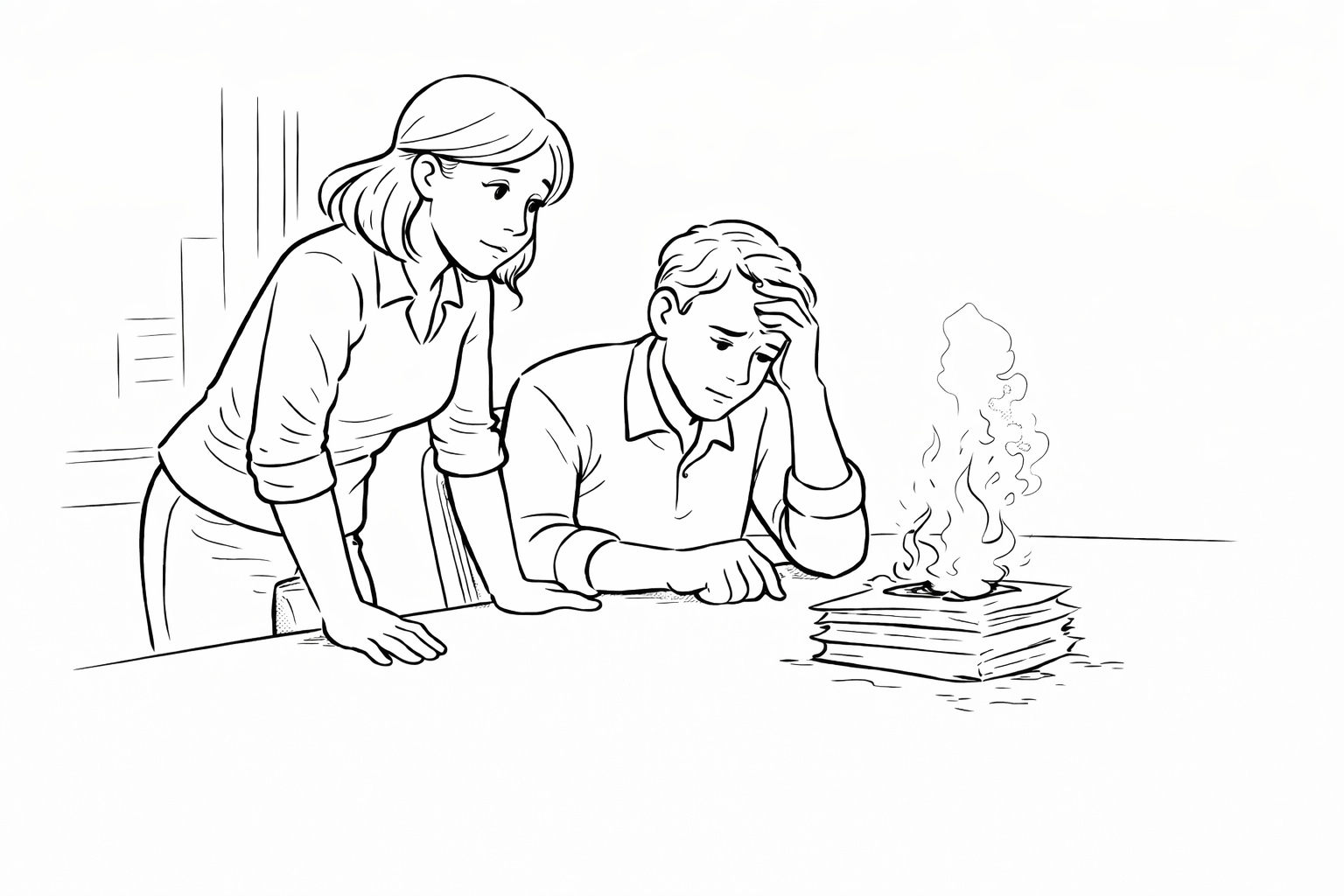
It’s Tuesday, 2:00 p.m. Marianne is sitting with her management team for the umpteenth time to discuss a problem that should have been resolved months ago. Another incident, same pattern. Someone says out loud what everyone is thinking, and then the reactions follow: escalate faster, more control, tighter processes, another meeting.
What they don’t see is that such reactions make things worse.
The Righting Reflex: Well-Intended, Counterproductive Effect
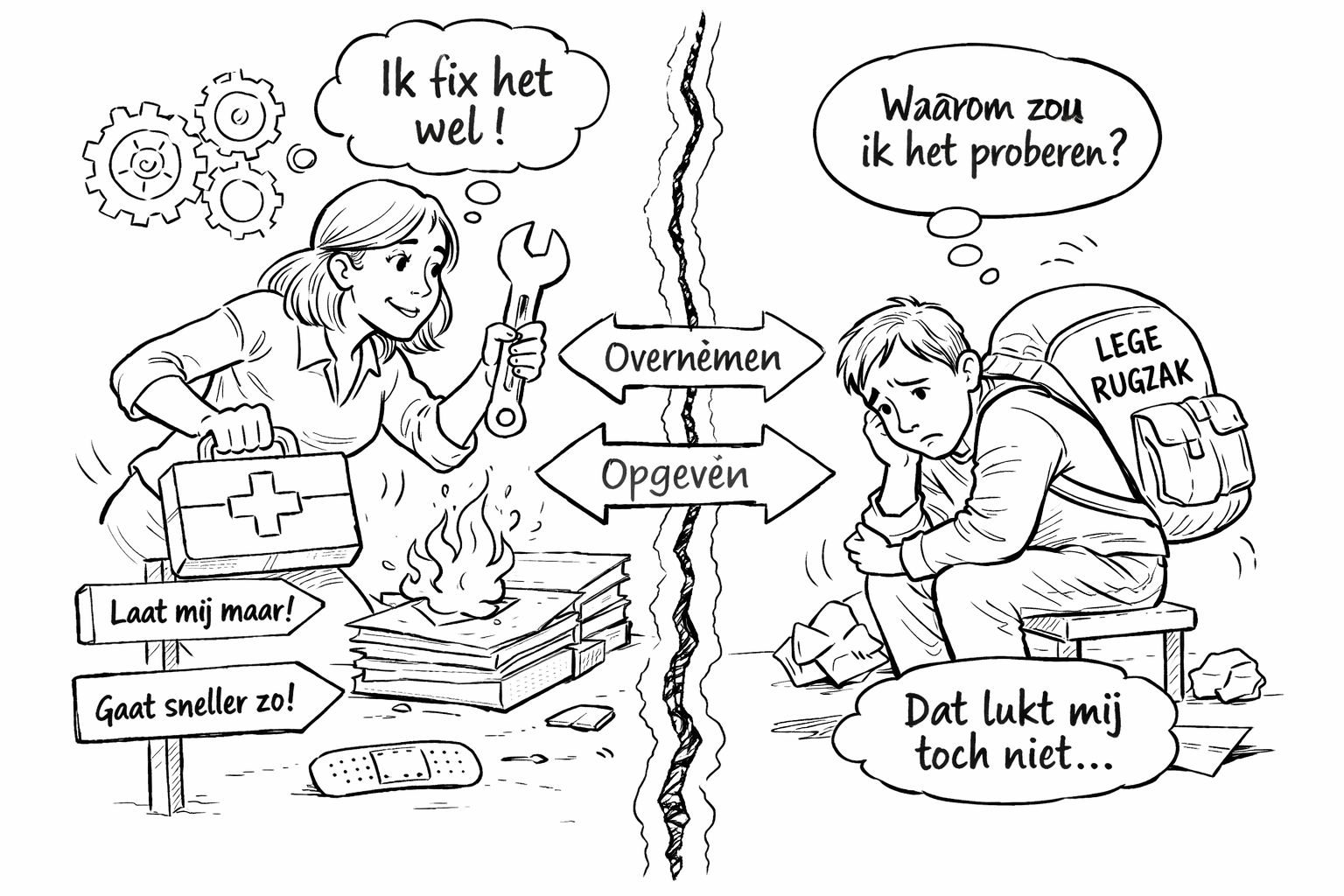
As managers, we see a problem and want to solve it as quickly and efficiently as possible. That feels like leadership. What we do is called the righting reflex in psychology: the automatic tendency to restore order by solving problems for others. Miller and Rollnick described this phenomenon extensively in Motivational Interviewing and aptly renamed it in their most recent edition the “Fixing Reflex”: the urge to fix what seems broken.¹
We feel responsible, we take action. That’s what leaders do.
But what we don’t realize is what this does to our teams. Every time we intervene quickly, every time we fix the problem for the team, we take away something essential: the opportunity to solve it themselves and learn from it. We solve the symptom, but we create a culture in which people wait for someone else to fix it. In which initiative is not rewarded, but mistakes are punished; “you could have prevented this.”
Marianne


Learned Helplessness
This reaction is palpable, but difficult to name. Until you recognize it for what it is: learned helplessness. A psychological phenomenon, first described by Seligman and Maier (1967), in which people, after repeated experiences of failure, even when circumstances change, stop trying. ² They believe that their efforts make no difference. They no longer do what is necessary; they do their best not to be blamed when something goes wrong.
That is why the problems keep recurring. Not because we have not solved them, but because we have indicated that it was not up to the team to solve them.
The Unintended Effect: More Control, More Energy Loss
We think that with the extra actions, we are preventing it from happening again. However, the effect is that we are taking away the team’s source of energy.
In the Job Demands-Resources model (Bakker & Demerouti, 2007), researchers describe this pattern: high job demands without sufficient resources cause energy loss instead of motivation. ³ Too many tasks, too much control, too little autonomy, too little trust. Too little opportunity to learn from mistakes together. What you create is mental retirement and ultimately: even more incidents.
It’s like a boomerang. We try to ward something off, and it comes back, but harder. The righting reflex reinforces the very pattern you want to break.
What We Learned from three of some of Our Favorite Authors
We are not the only ones who have noticed this. Three authors described this in different ways, not from abstract theory, but from the practice of coaching and leadership. What connects them is that they all focus on increasing what you might call the team’s backpack, the ability of people to set their own direction, make choices, and learn.
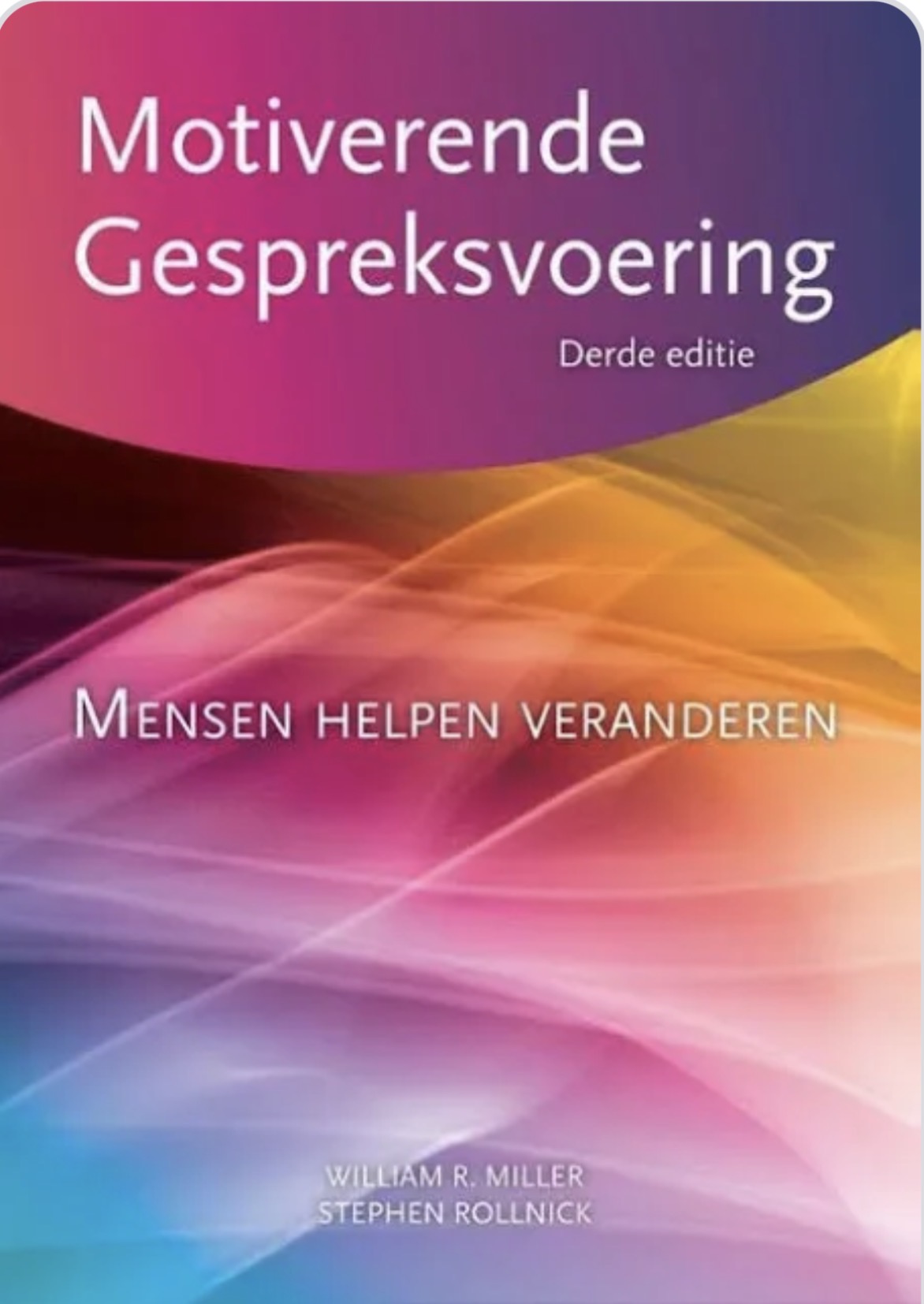
Motivational Interviewing, Miller and Rollnick
In Motivational Interviewing, Miller and Rollnick show that the moment we start persuading someone that “you have to do this differently,” we generate resistance.¹ People withdraw, defend their current behavior, and become passive. The righting reflex feels good to the manager, but to the team it feels like control.
The alternative is to elicit rather than impose. Motivational Interviewing is a conversational approach in which you actively listen to what someone already knows, feels, and wants. You ask open-ended questions. You reflect back what you hear, you name the other person’s motivation, not your own. “What makes this important to you?” “What would you do if you knew it would work?” It’s not about convincing the other person. It’s about the other person convincing themselves. This is fundamentally different from how most management conversations unfold.¹
Coachen 3.0, Sergio van der Pluijm
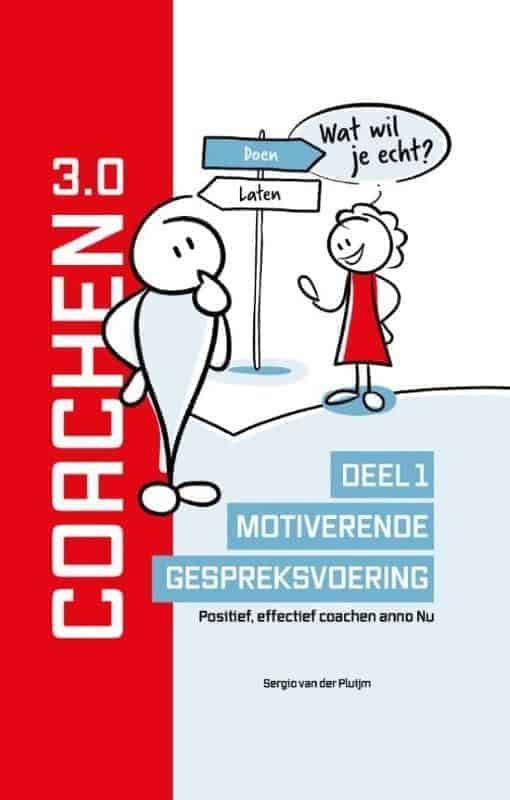
Sergio van der Pluijm builds on this directly in his three books on solution-focused coaching and motivational interviewing. ⁴ Whereas motivational interviewing focuses on eliciting intrinsic motivation, solution-focused coaching adds a practical conversation structure that focuses on possibilities rather than problems. Not: “How did this go wrong?” But: “What already worked? What do you want to be different? What is a small step you can take tomorrow?”
This sounds simple. But it requires a fundamental shift on the part of a manager or coach: you step out of the role of problem solver and become a curious conversation partner. You stop filling in the blanks and start asking questions. And the team, the employee, the student, begins to fill their own backpack: with insights, with self-confidence, with a perspective for action. Not because you suggested it, but because they discovered it themselves.⁴
Turn the Ship Around!, David Marquet
David Marquet describes the same movement in his book Turn the Ship Around!, but at the organizational level. ⁵ He transformed the worst-performing submarine in the US Navy into the best, not by imposing more rules, but by exercising less control. By treating his team members as leaders rather than followers. By sharing his intentions (“this is where we are going”) and pushing authority to those with the information (“you know best how to get us there”). The result was not chaos, but alertness, ownership, initiative. The direct opposite of the righting reflex.
Together, these three authors show that the more you, as a leader, provide the answers, the less the team learns to find them for themselves. The more you impose/solve, the emptier your team’s backpack becomes. And the emptier the team’s backpack, the more fires you have to put out.
The System View: Pattern or Coincidence?
Recurring problems are rarely coincidence; they are signals. Signals that something is structurally wrong somewhere in your system.
The righting reflex focuses on the incident. The system view focuses on the question behind it: why does this keep coming back? What rules make this pattern possible? What incentives reward putting out fires and get in the way of structural solutions? What structure causes people to wait instead of act?
The JD-R model helps to find concrete answers to these questions. ³ If a team has structurally high task demands but few resources (autonomy, trust, room to learn from mistakes), then this is not a personal problem, but a system problem. System problems are not solved by working harder or monitoring more strictly. You solve them by restoring balance: less pressure where possible, more resources where necessary.
In practice
In practice, this means giving more autonomy, being clearer about frameworks, creating space for reflection, and treating mistakes as learning opportunities to be celebrated rather than risks to be avoided. Small shifts in the system can have a big impact on the pattern.
Shared Wonder: The Moment When Something Changes
What we regularly notice in our coaching of organizations is this: the moment you, as a leader, recognize that you are part of the pattern, something powerful happens. No blame, no shame. Just: “I recognize this. I see it in myself too. I feel my own repair reflex.”
If you dare to share this, mutual recognition can arise. Researchers call this shared wonder. And this is exactly what works.⁶
Shared wonder arises when you focus on something that affects everyone. Not “you did it wrong,” but “what is actually happening to us as a team?” Research shows that this deactivates the part of your brain that constantly thinks about yourself and your position.⁶ Instead, both parties are absorbed in something bigger: the shared question of why patterns repeat themselves.
When you say, “I see how I did that and why it didn’t work, I feel my repair reflex, and I’m curious about what you see,” the dynamic changes fundamentally.⁷ You’re not diminishing yourself. You’re making yourself approachable, which shows that you’re big enough to grow.
This is the core of what we do as coaches and trainers. Not solving problems. But entering that state of wonder together with teams: what do these patterns tell us? How do I turn my righting reflex into a desire to learn?
Research confirms that shared wonder leads to real behavioral change, more than any other coaching moment.⁶ ⁷ Not because someone tells you what to do, but because you see, feel, and understand together what is really going on.
The link with our previous blog
This article ties in with our previous blog post “When Priorities Collide: The Missing Compass of Customer Value,” in which we describe how unclear priorities lead to internal fragmentation and a loss of shared direction.
This story looks at things from a slightly different perspective. Where Priorities Collide looks at overarching (customer) value, while here we look at the energy sources your team needs to translate that clarity into action. These two are inextricably linked. Without clarity about what and why, no team can mobilize energy. But without energy sources, autonomy, trust, and room to learn, that clarity remains up in the air. And without letting go of the righting reflex, ownership cannot grow.
Getting started in practice: The Engagement Scan
Insight alone is not enough. Make sure it becomes tangible and visible and that you do something together.
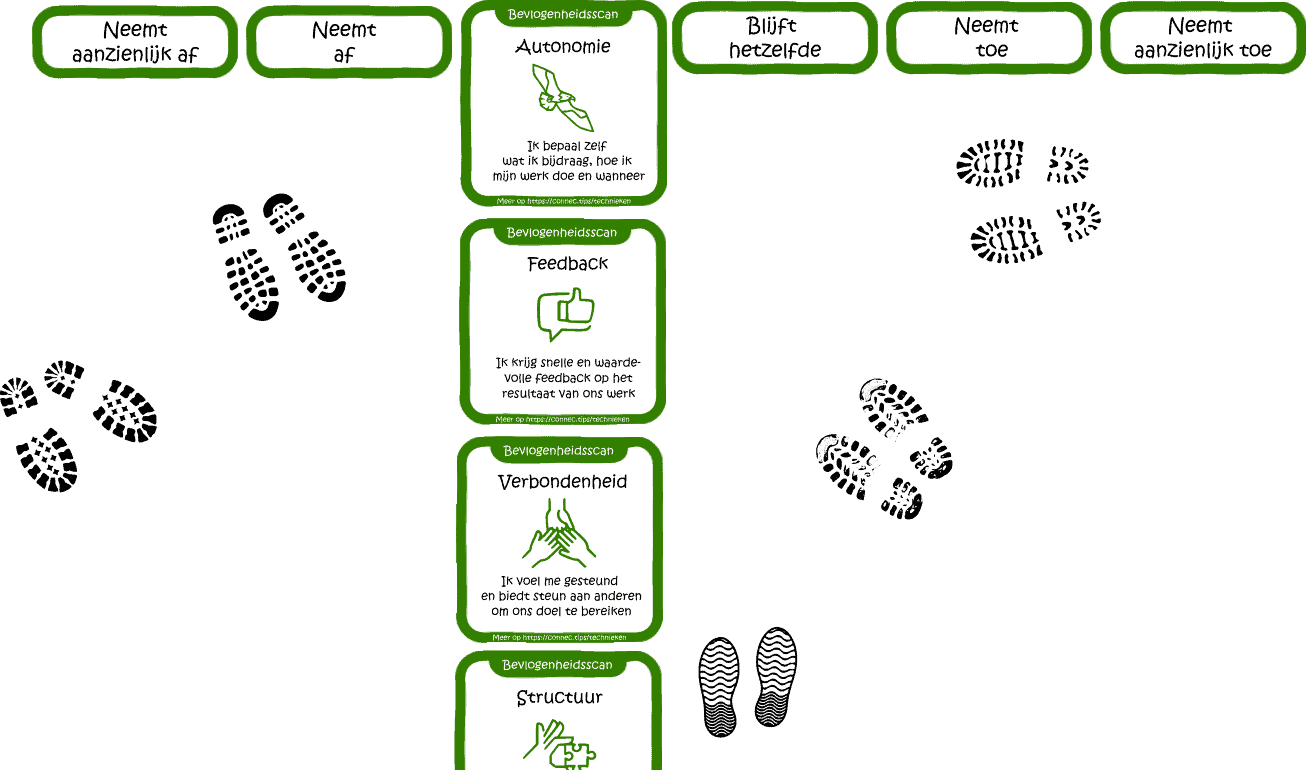
That is why we work with the Engagement scan, a working method that builds directly on the JD-R model.³ This tool helps teams to visualize their own energy sources and task demands. Not as an abstract concept, but as a concrete, shared experience.
The technique is simple. Together, you identify which energy sources are most relevant to your team, such as autonomy, trust, clarity, psychological safety, learning opportunities, and appreciation. You ask two questions:
Where do we currently get our energy from?
Where does the team lose energy?
By regularly using this technique, together, not as an assessment but as an investigation, you can reveal the pattern of energy loss before it leads to exhaustion. You break the silence in which problems repeat themselves. You create space for a joint question: what resources do we need now to break this pattern?
This is not an external diagnosis. This is self-exploration from within. That makes all the difference.
Sources
¹ Miller, W.R. & Rollnick, S. (2023). Motivational Interviewing: Helping People Change and Grow (4th ed.). Guilford Press.
² Maier, S.F. & Seligman, M.E.P. (1976). Learned helplessness: Theory and evidence. Journal of Experimental Psychology: General, 105(1), 3–46.
³ Bakker, A.B. & Demerouti, E. (2007). The Job Demands-Resources model: State of the art. Journal of Managerial Psychology, 22(3), 309–328.
⁴ Van der Pluijm, S. (2020). Coaching 3.0; (2018).
Motivational interviewing; (2022). Solution-focused interviewing. Boom publishers.
⁵ Marquet, L.D. (2012). Turn the Ship Around!: A True Story of Turning Followers into Leaders. Portfolio/Penguin.
⁶ Stellar, J.E. et al. (2018). Awe and humility. Journal of Personality and Social Psychology, 114(2), 258–269.
⁷ Keltner, D. & Haidt, J. (2003). Approaching awe, a moral, spiritual, and aesthetic emotion. Cognition & Emotion, 17(2), 297–314.
 English
  Nederlands
  Deutsch
  Français de Belgique