

Scientific research shows that it is possible, with more focus, transparancy and better decisions.
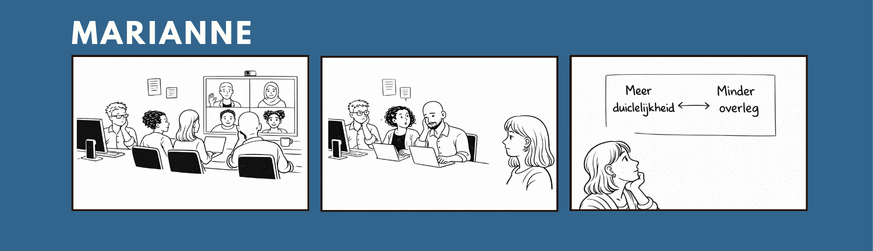
Almost every manager recognizes the tension: schedules are filling up, meetings are piling up, and yet you get the feeling that everything is just getting more complicated. Our reflex is then to consult even more or, conversely, to stop consulting altogether. However, research shows another solution: visual management.
In this blog, we explore what recent studies show about meetings and what that means for teams that want to work together without drowning in meetings.
Summary
Research shows that meetings mainly get stuck when goals are unclear, status remains invisible, and different types of discussions are mixed together. Larger meetings and too many participants demonstrably lead to a loss of productivity.
Teams that work with clearly defined consultation goals, visual management, and explicit consultation types achieve up to 50% less meeting time and greater transparency. Not by managing more strictly, but by making it clearer what the discussion should be about.
Less consultation rarely starts with cutting back. It starts with clarity.
When meetings lose their purpose
A first pattern that recurs in several studies is the size of meetings. As soon as the number of participants increases, effectiveness quickly declines. Research by Atlassian shows that meetings with more than eight participants lose an average of 62% more time to non-essential discussions.
This picture is confirmed by a classic study by Harvard Business Review: 71% of employees say they sit in meetings with people who are not necessary for the intended result. The effect is concrete: an estimated productivity loss of 15 to 20%. Not because people are not doing their best, but because the purpose of the meeting does not sufficiently filter out who is really needed.
The goal as the primary organizing principle
Research by McKinsey & Company shows that purposeful invitations (What is the goal? What role do we expect from you?) reduce the number of participants by an average of 40%. At the same time, these teams reported 28% more clarity about decisions and next steps.
This is in line with the ideas presented in Patrick Lencioni’s book Death by Meeting. He shows that much frustration does not arise from too many meetings, but from the fact that different levels (strategic, tactical, operational) are mixed together. When the purpose of a meeting is explicit, it becomes clear who is needed and who is not.
Transparancy reduces meeting pressure
A second strong theme in the research is the effect of visual management. Teams that make their progress, bottlenecks, and priorities visible appear to need significantly less coordination.
McKinsey reports that visual boards and dashboards reduce the need for status updates by approximately 50%. At the same time, perceived transparency increases by approximately 30%. People need to ask fewer questions because they can see more.
Academic research also shows this. Studies published in the IISE Journal show that teams working with Kanban boards need 35% fewer participants in meetings on average. The reason is simple: status is already visible, so meetings can focus on meaning and choices rather than gathering information.Lean studies show that escalations decrease by approximately 40% and are more often resolved on the same day in environments that work with an Obeya-like space (or a light variant thereof). Not by managing more strictly, but because problems are shared and reviewed together more quickly.
Different types of meetings, different effects
A third pattern is the explicit distinction between types of consultation. Research by The Table Group (Death by Meeting by Patrick Lencioni) shows that teams that work with clearly distinguished forms of consultation, such as operational check-ins, tactical decision-making, thematic meetings, and strategic sessions, need 30 to 50% less total meeting time to reach good decisions.
The benefit is not only in time, but especially in focus. A study in Harvard Business Review shows that when each type of meeting has its own purpose and rhythm, the quality of information and decisions increases noticeably. Differences of opinion are brought to the table more quickly, allowing everyone’s expertise to be better utilized.
Rythm matters: don’t minimize everything
Interestingly, research also warns against going too far. Data from the State of Agile Report shows that daily stand-ups of up to 15 minutes contribute to faster resolution of operational bottlenecks, with a reported productivity gain of 20 to 30%.
At the same time, the opposite is true for larger work meetings: shortening sessions is counterproductive. For PI Planning-type meetings, a two-day format results in approximately 30% better alignment. When this is reduced to one day or half days, confidence declines and rework actually increases.
The lesson is clear: some conversations require pace, others require space.
What this shows us
When we compare these research results, a consistent picture emerges. Less consultation and more clarity are not achieved by a single measure, but by a combination of three principles:
- A clear consultation goal as a filter. Fewer participants, more focus.
- Visual management. Less status consultation, more joint control.
- Distinction between types of consultation. Less confusion, better use of expertise.
Teams that combine these elements demonstrably achieve:
- 30–50% less total meeting time
- 30% more transparency and alignment
- Faster decision-making and fewer escalations
Not because they collaborate less, but because they collaborate in a more focused way.
Reflections
So perhaps the question is not how we can consult less. Much consultation becomes unnecessary once we make goals and plans visible. In addition, it helps to make conscious choices about exactly what we want to meet for. Finally, it helps to set up separate consultations for different levels of decision-making and to establish a rhythm for these.
Not less coordination. But more clarity.

 EN
EN  NL
NL  DE
DE  FR
FR 